


Sep. 05, 2024
Published: September 5, 2024 – Revised: June 17, 2026
How to Write Shadowdark Adventures

If you're here, you must be considering how to write Shadowdark RPG adventures. These adventures are similar to 5e adventures but closer in style to Old-School Rules games. First, I am not an expert like Kelsey Dionne or other adventure writers, but I have studied Adventure Writing in depth over the last couple of years and have developed a system others can benefit from.
My name is Frey Bugbee, and I have written one free adventure, a class supplement, and a bunch of home game scenarios at the time of writing this article. I also contribute to Shots in the Dark and have new content currently being developed. Come back here to see what I've cooked up.
This article is inspired by Kelsey's on writing 5e adventures, and I thought it was time for a breakdown of a Shadowdark-focused How to Write Adventures as there are new considerations.
Start Writing a Shadowdark Adventure
Let's just assume you've read Kelsey's excellent article. The seven steps in that article apply to Shadowdark Adventures, so keep those steps in mind if you want to publish professionally or write engaging adventures your players will love.
Urgency. All adventures need a problem to solve, an issue to fix, a difficulty to overcome. It must be an obstacle that has gravity upon the player's involvement. These topics can typically be brainstormed with Adventure Generator tables.
Shadowdark RPG has two great options to use depending on how you want to be inspired. The Adventure Generator on page 122 and can be found in Kelsey's article, is a great resource to inspire.
Let's delve into this dungeon.
fill
fill
As the Loot the Room article illustrates1...how you construct an adventure and present it on the page is determined by the system you're writing for. That's not to say that it's inherent to the system in any way...but because the first-party publishers include this stuff, the audience comes to expect it., to connect with your Game Master audience, you must write your adventures in the style recognizable by the established content, typically written by the "house" or original creators. With this in mind, The Arcane Library is the source.
Please note:
fill
fill
The Basic Elements of Shadowdark Adventures
If you've read Adventures designed for Old School Rules (also known as OSR but defined as Old School Revival or Old School Renaissance), you know that the styles and structures vary quite a bit. Again, this article aims to define a "house" style for Shadowdark Adventures. Let's delve deeper!
Analyzing the fundamental elements that make up a Shadowdark Adventure helps GMs get on board and quickly gain perspective on what story they're trying to tell. Using the example of FotBB and HotSWK, here are the elements that make up the anatomy of a Shadowdark Adventure:
- Overview
- Room Key - GM vs. PC Info
- Background - A Short History
- Factions
- Game Details
- Locations - Named Areas
- Entrances and Exits
- Rumors
- The Areas
- Features - Dangers, Dimensions, & Light
- Encounters
- Area Details
- Title
- Room Description
- Bulleted Details
The Overview
The first section, Overview, has multiple components that should always be used but may have some optional sections depending on the adventure you write.
1. Room Key
One element that Adventure Writers often overlook is the Room Key, or what I call "To Share or Not." This quick note defines how GMs should use the Area Details (which we will get to later in the article).
The Room Key looks like this:

The Room Key tells GMs to use the room descriptions as read-aloud text or paraphrase this information when PCs enter the area. Bulleted details are intended to be revealed as PCs explore or interact with the elements.
This helps allow GMs to use an adventure at the table with minimal prep.
2. Background
The Background sets the stage for the adventure. It provides hints of lore and describes the perilous situation the PCs are about to face.
This one—or two-paragraph section tells the story of danger at the location. It helps GMs understand NPC interactions, scenarios, and possible adventure solutions.
For example, in FotBB, two brothers, Malik and Gaspar, compete for the same goal: to inherit their father's title.
The background tells us that the brothers must prove themselves and one of them must die. As GM, you gather that PCs may want to play the brothers against each other or at least stay out of their way.
In HotSWK, rumors say the mighty sea wolf king still clutches his treasures. The legend of the king still circulates amongst the people in the area, setting up the potential for deadly encounters and a showdown.
The Background, while providing essential information, should be kept brief and to the point. This brevity allows the GMs to add their own creative elements to the adventure, making it unique and engaging for their players.
3. Factions
A Faction has an agenda. Defining the groups that PCs face helps the GM understand how an encounter with a faction member might be played.
Factions are directly opposed and fight over the same resources. Factions often have a leader, master, and a key NPC and are included in the Random Encounter table (more details in Encounters below).
A faction could be a singular type of monster or a collective of monsters dominated or controlled by an entity or a more powerful monster. Factions are the GM's Actors on the Stage. A faction should hold a secret or hide a pivotal clue to the revelation of power and treasure and potentially offer a partnership.
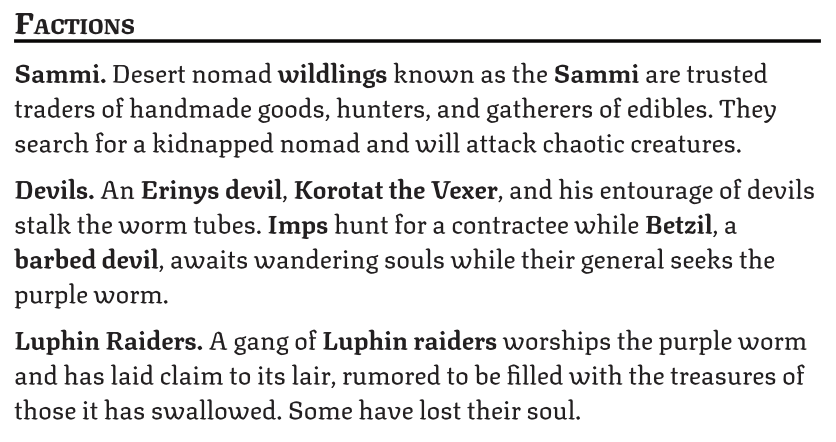
The Factions in FotBB are excellent examples of factions with a leader and key NPC. Malik and Gaspar are commanders, potentially Big Bad Guys or partners, who lead powerful servant NPCs Halim and Rashik.
Faction members typically appear in specific areas and appear on the random encounters table.
4. Game Details (Optional)
Do you have a specific set of rules that apply to this adventure? This is the place to define custom or specific rules. Do all players need to start with a particular condition? Is this a Gauntlet adventure, and would you like to remind GMs of the details?
Keeping the rules simple is essential. GMs already have much to remember. In HotSWK, a reminder of the Gauntlet rules helps GMs remember important bits and refer to the official rules.
5. Locations
Your adventure may have different areas that need extra description. This includes a couple of sentences painting a picture for GMs to describe later.
If your Location has two different types of areas, you could describe their Features here. This would include the dimensions and unique elements of the space, including the height of ceilings, the depth of a lake, or the specifics of a building or structure.
You can see more about Features under Area Details.
Here is an example of a Location description:
Gloomwind Mines
An old mine lost to time and magic is cut deep into a ravine of solid stone. Long ago, the Order of Gehemna concealed the mine with magic to protect powerful relics from evil hands. The rocky entrance, now revealed, leads to jagged basalt mine shafts and picked-and-shoveled caverns that now host dangerous conditions, wild beasts, and ensorcelled spaces.
6. Entrances and Exits
When you write your adventure, you may need to explain how PCs might enter the location. If your dungeon is designed with one entrance, you may run the risk of railroading GMs and PCs down a linear path. Be sure to Jaquays your dungeon and offer multiple routes through your location, then define them for the GM.
This section helps define options for PCs to approach a location and have some agency. Entrances and Exits can be a dedicated section and heading, or these details could be included in the Location section, like the example here:
Seragir Chapel
The ruined chapel stands in defiance, overgrown from the outside, with vines twisting over muted and broken stained glass windows. The stone house connects to the chapel and sits dark and foreboding. Covered in dirt and moss, a worn path connects to the entrance.
Entrances and Exits. Entry into the chapel is apparent at Area 1 on the south side. Area 7 from the north is noticeable but has no defined path. PCs searching the exterior can find an obscured entrance into Area 5 if they closely examine the perimeter.
7. Rumors
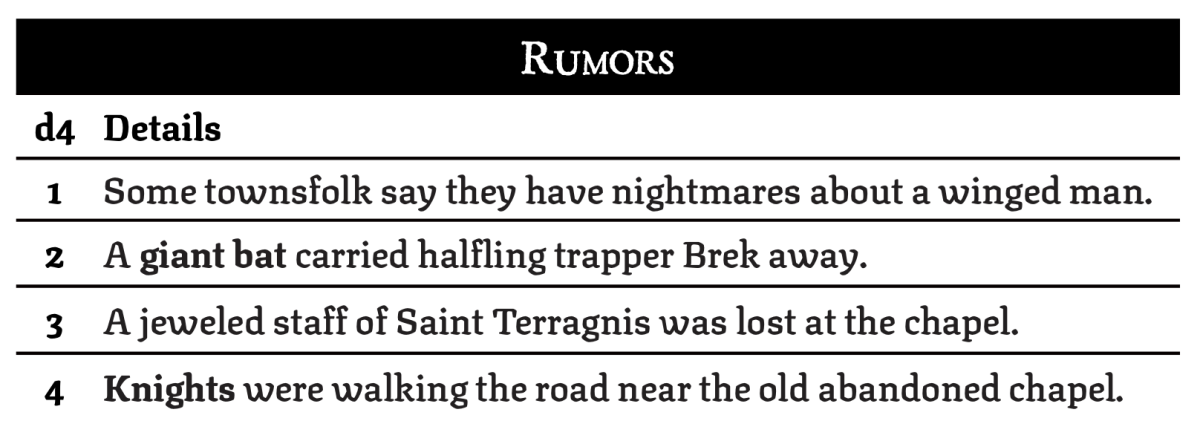
Perhaps one of the most essential elements of an adventure, the Rumors table typically bookends the Overview.
Displayed as a table with a heading and a declaration of a die type, this Roll Table typically has six numbered options that help hook PCs into the adventure. These options may be formatted as quotes from NPCs, overheard statements, or stories known by characters in the adventure world.
Having a minimum of four Rumors is acceptable but no more than eight.
The Areas
This portion of the Adventure is one of the most vital pieces of writing. At the table, GMs will look for bits to read aloud and bullets to inform situations. Being concise, providing flavor, and detailed descriptions help GMs succeed with little time spent preparing.
1. Features
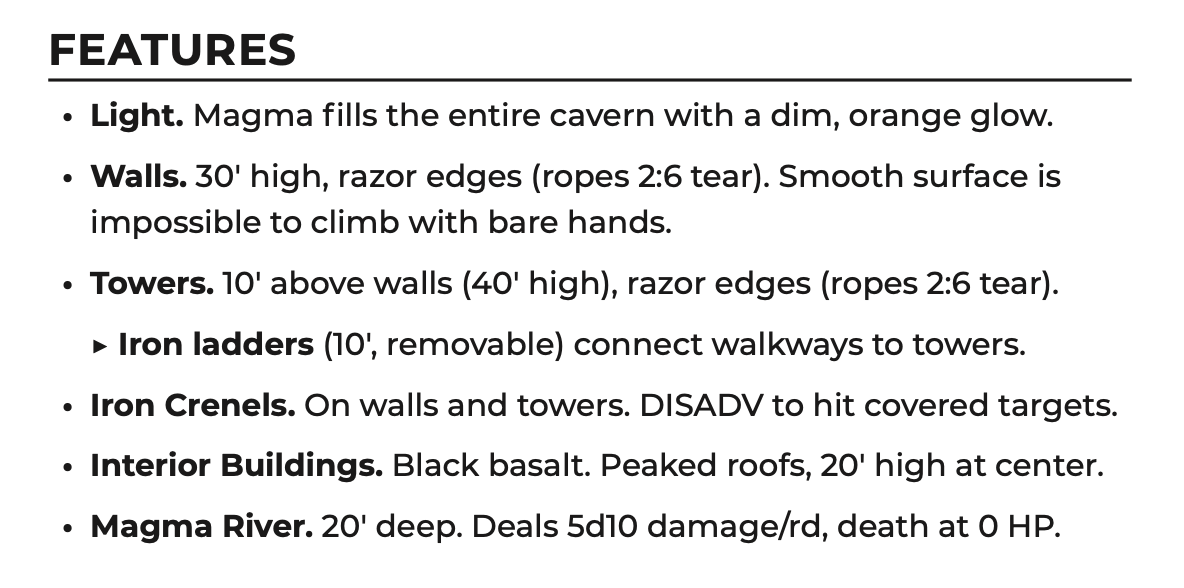
You may decide to have more than one area in your adventure and need to define specific Features. This section defines the Light levels, Walls, Unique Structures, and Dangerous Obstacles.
Each feature can be displayed in one of two ways:
- With bullets followed by a bold keyword and period, as shown below.
- Forego the Bullets and use bold keywords and a period.
Please Note: In this humble writer's opinion, any player-facing content should be written without bullets. I prefer using the Room Key throughout the Adventure sections. By that, I mean Descriptions in the Overview could be shared with players if it makes sense to the GM.
2. Encounters
At the top, an instruction for using the Random Encounters table defines how often a check is made. This comes directly from the Shadowdark rules.

Closely tied to Factions, the Random Encounters table is a tool that throws themed monsters at your players, unifies your Adventure, and helps GMs introduce faction agents to interrupt or interact with your PCs.
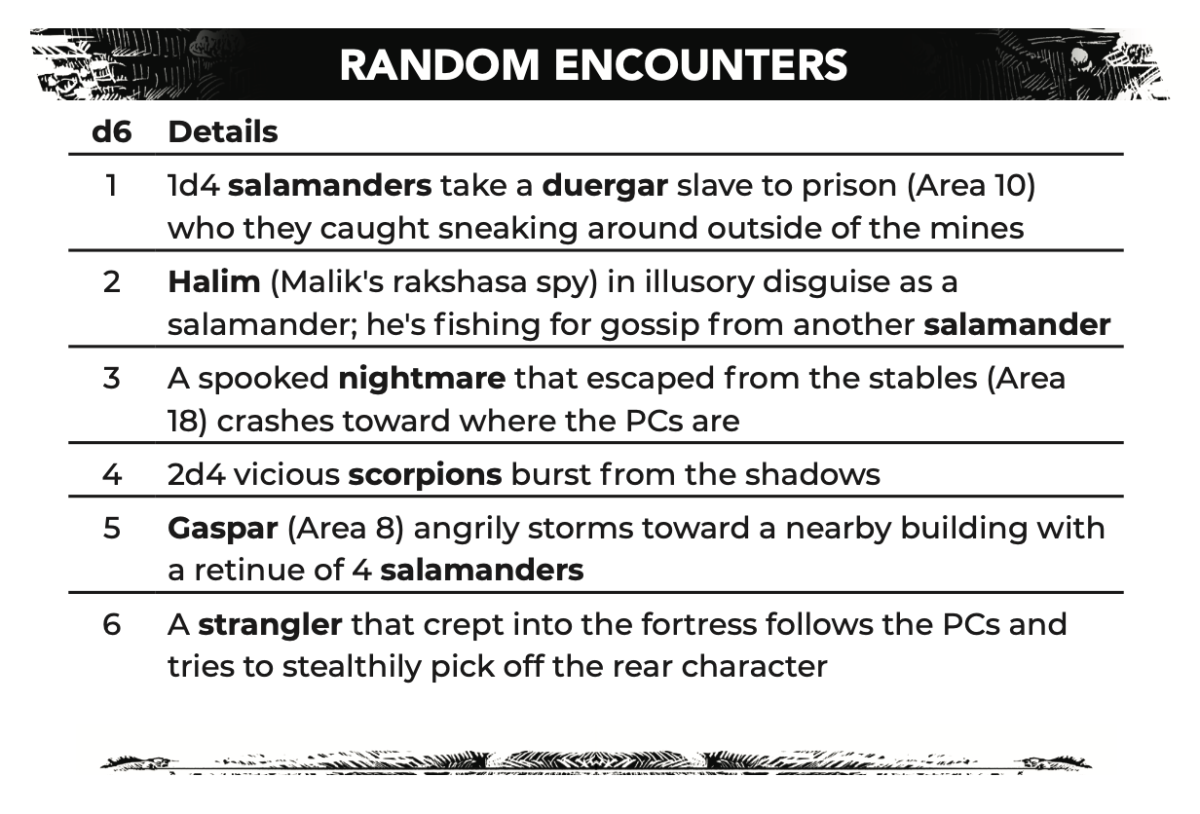
The Encounters section defines a Faction's precise actions, explains the Order of Battle, and details faction actions and combat.
Notice how FotBB adds the Danger Level in this example:
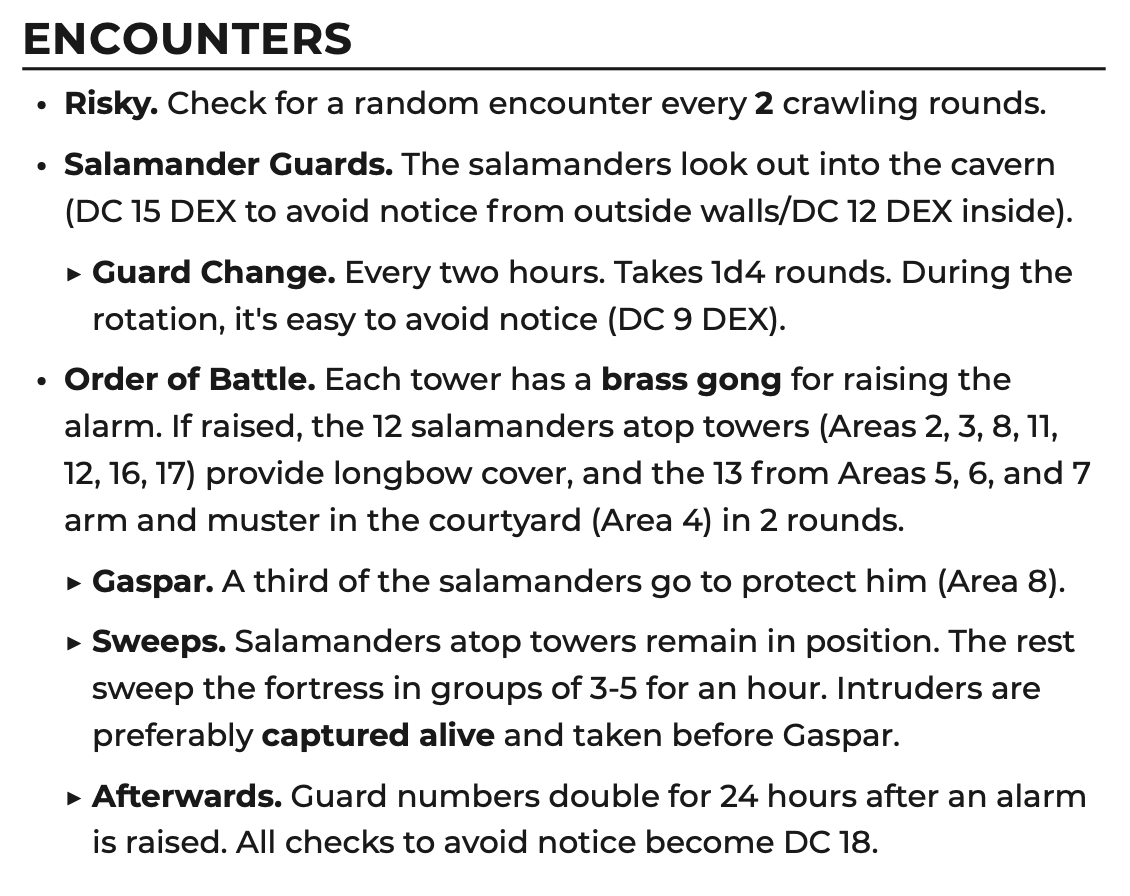
The Order of Battle and the Faction bullets specify the actions of monsters and NPCs. In this example, the GM knows that the Salamander Guards are given an objective (capturing intruders) and specifics for combat if PCs are discovered (stop intruders at all costs) and increasing guard numbers after the alarm is raised.
This section should be utilized whenever there are specific instructions for wandering monsters or special requirements for NPC interactions. If you choose to have your Adventure lack NPC leadership, then relying on the Random Encounter table is ideal.
3. Area Details
The first element of an Area, the Title, is self-explanatory. However, note that the numeric indicator corresponds to the area on the Adventure map.
The second and third elements, Area Description and Bulleted Details, need more explanation. Remember and understand that these details help GMs use the Adventure at the table with minimal prep.
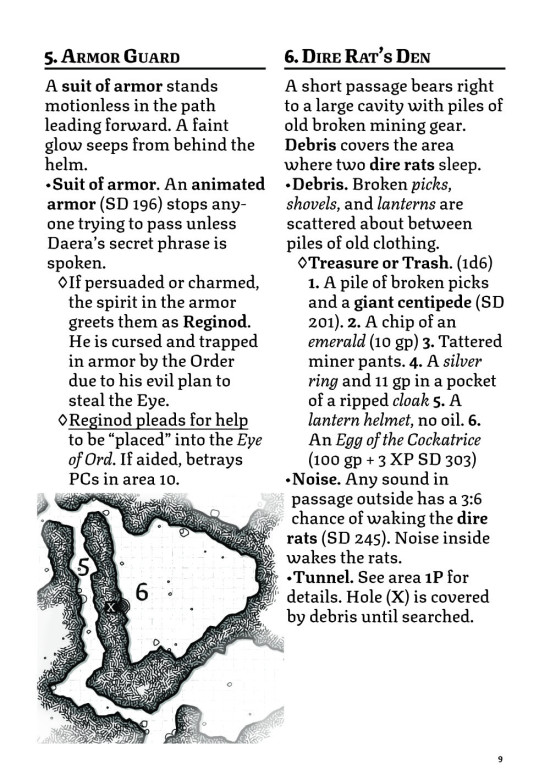
Let's look at an example from The Arcane Library's HotSWK:
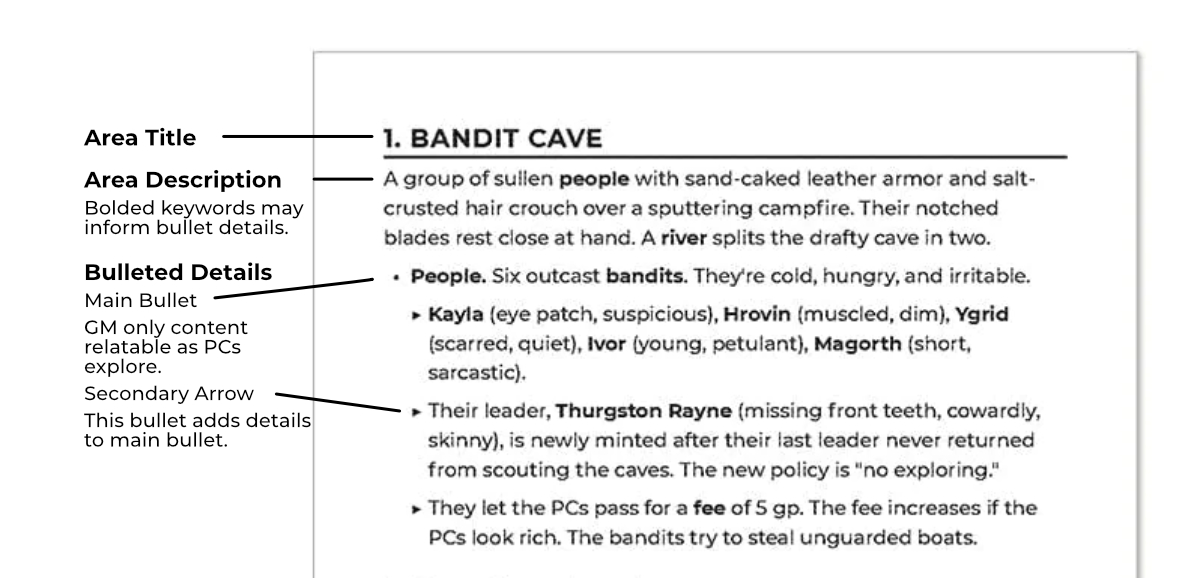
Area Descriptions in Shadowdark use bold keywords. These keywords may be bold to draw attention or to denote content to be elaborated upon within the Bulleted Details. Room Descriptions intend to be shared with players. Early adventures, including the "Lost Citadel of the Scarlet Minotaur," use the Old School Essentials style with bolded keywords followed by a colon and sharable descriptors. What changed in the long-form adventures in Cursed Scrolls 2 and 3 were descriptions written in sentence form, making them easier to read aloud.
Bulleted Details have two parts: the Main Bullet and the Secondary Arrow. Both types have the most information for the GM.
The Main Bullet introduces the scenario and gives some detail, usually starting with a bold keyword mentioned in the Room Description followed by a period like this:
- People.
Sometimes, the bold keyword is unique and is not mentioned in the Room Description. More on this later. The Main Bullet may also have additional bold keywords that emphasize an idea or refer to a keyword defined in a Secondary Arrow. This content may also include italicized item names found in the Shadowdark rules.
As you may have guessed, the Secondary Arrow bullet provides detailed information about the Main Bullet. This bullet content may also have bold keywords for emphasis, refer to a monster name, or reference italicized items. It is also worth mentioning that both bullet types may use parentheses to give descriptive context to NPCs, list the value of items, or give context to the previous part of the sentence. To reiterate, elaborating on the host bullet content and providing details and specifics for the main bullet topics is what the Secondary Arrow bullets accomplish. Remember, bold keywords may add emphasis only, calling attention to the eye for quick reference.
As mentioned earlier, there is another form of a Main Bullet bold keyword. It is displayed as a bold keyword and ends with a period, referencing no keyword in the Room Description. Rather than referencing a keyword, this Main Bullet defines vital information for the GM.
Let's break it down piece by piece:
Title -
1. BANDIT CAVE
Room Description -

In this example, people and river are bold. People is an example of a keyword that will have a Bulleted Detail. River is an example of emphasis, drawing attention to GMs who may need to consider how the river comes into play.
Bulleted Details -
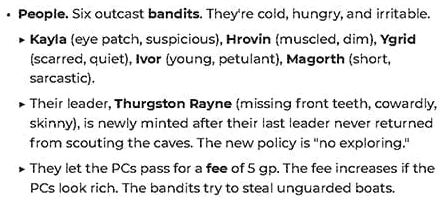
The Bulleted Details for People shares information informing the GM about the scenario's essential aspects and how to describe them once PCs investigate or interact. The bolded word "bandits" is an example of a reference to Shadowdark rules, requiring the GM to remember the monster name in the game rules to be able to reference the stats.
Bold keywords in the first Secondary Arrow refer to the names of the NPCs, while parentheses add helpful traits of the NPCs to convey to players if they engage.
The second Secondary Arrow explains the leader's traits and plants elements of the future story, hinting trouble lies ahead. These details help GMs formulate the NPC's roleplay motivation. As the GM brings this NPC to life, this text enables GMs to have a better understanding of how to play the role of Thurgston.
The third Secondary Arrow gives the GM the task of stealing the PC's boat if present. It also sets the GM up to start a fight. After all, these are bandits!
There is No Design Guide
There is a lot more to say on this topic. This article is not a Shadowdark Design Guide. This collection of paragraphs is my attempt at creating one for myself and anyone else interested in defining a structure, a style, or a form for writing Shadowdark Adventures.
You'll find multiple styles if you read through the Cursed Scrolls. Cursed Scroll 3, one of the zines used in my examples, contains a one-page adventure that doesn't use bullets, uses bold keywords (differently), and places GM-only content along with player-shareable information. This form, style, and structure still work as a format. It is not the focus of this article.
I selected to focus on FotBB and HotSWK due to several factors. I like their style! These adventures concisely convey more information and give GMs something to share with players immediately. This structure also creates a system for organizing GM information that reinforces, gathers, and aligns key elements shared in the story.
One aspect I wish was present in the Cursed Scroll adventures is map details for each spread. I've found other written adventures that take this approach and find it extremely helpful at the table.
There is so much more to say. For now, let me know if you have anything to add.
In the future, i will be adding my thoughts on what content finds its way into this format.